Were these ancient rules meant to guide every culture — including ours?
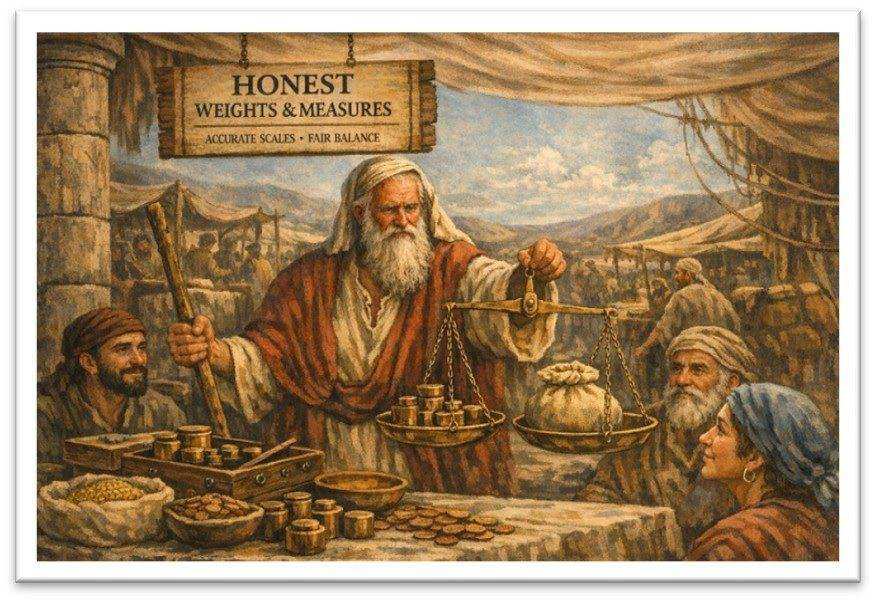
To explore that, we need to look at the earliest days of trade. According to NOVA, China was using metal money around 1000 B.C. But even earlier, in Moses' time, commerce depended on weights and measurements. Trade only worked if everyone agreed on the standards.
So, when Moses wrote, "Do not use dishonest standards… your scales and weights must be accurate," he wasn't offering a religious suggestion. He was establishing the economic foundation of a nation. And he wasn't alone. Over the next two centuries, multiple biblical authors repeated the same theme: Honest weights. Honest measures. Honest means of exchange.
It was the backbone of a stable society.
The Power of Fixed Measurements
Our entire culture still depends on fixed units: 12 inches in a foot, 3 feet in a yard, 16 ounces in a pound, 32,000 ounces in a ton. The U.S. Constitution empowers Congress to fix weights and measures. (See Article I, Section 8, Clause 5.)
Imagine watching a football game where the referees quietly changed the definition of a yard. Or playing Monopoly with your grandkids and the eight-year-old banker keeps raising the price of every property. You'd quit. Everyone would. Standards matter.
And yet, while we would never tolerate changing inches or ounces, we've accepted a monetary system where the value of a dollar changes every second of every day. The dollar — our national unit of economic measurement — is no longer fixed. It floats. It drifts. It erodes.
Most Americans alive today have never lived under a gold standard. We've only known a fiat dollar, a currency created at will, with no intrinsic value behind it. When we trade our labor for dollars, we assume those dollars will hold the value of our work. But when money can be created "out of thin air," the measurement becomes dishonest — even if unintentionally so.
And dishonest measurements always hurt the people who can least afford it.
Back to 1400 B.C. — A Nation Built on Honest Measures
When Israel left Egypt and formed a new nation, God gave them laws that shaped everything from worship to economics. Even if someone doesn't believe the Bible, it's remarkable how clear and consistent these monetary principles were.
Deuteronomy 25:13–15 (NLT)
"You must use accurate scales when you weigh out merchandise, and you must use full and honest measures. Yes, always use honest weights and measures, so that you may enjoy a long life in the land the LORD your God is giving you."
The message is unmistakable: a society cannot thrive when its measurements are corrupt. The prophets condemned merchants who mixed grain with chaff or used rigged weights to cheat the poor. Proverbs calls dishonest scales "detestable." The Levites were even assigned to check the weights and measures — an ancient version of the Bureau of Standards. This wasn't just about economics. It was about trust, justice, and the dignity of every person.
Were These Principles Meant for Us?
Our Founding Fathers thought so. They lived through the collapse of colonial paper money and the disaster of the Continental Dollar. They saw firsthand what happens when a nation manipulates its own currency. So when they wrote the Constitution, they intentionally tied money to precious metals — a standard that couldn't be printed, inflated, or manipulated.
Their warnings sound almost prophetic now:
- George Washington: "Depreciation keeps pace with the quantity of the emission."
- George Mason: "Paper money is founded upon fraud and knavery."
- Oliver Ellsworth: "Shut and bar the door against paper money."
- Thomas Jefferson: "The end of democracy… will occur when government falls into the hands of lending institutions."
- Andrew Jackson, confronting the central bank: "You are a den of vipers and thieves."
These weren't fringe voices. These were the architects of our nation. They believed honest money was essential for a free people.
The Legacy Builder's Question
So here we are — thousands of years after Moses, hundreds of years after the Founders — still wrestling with the same issue: can a society flourish when its measurements are constantly changing?
Legacy Builders know the answer. Whether you're running a business, leading a family, or stewarding resources, the principles are the same:
- Integrity in small things creates stability in big things.
- Honest measurements build trust.
- Trust builds nations.
The ancient world understood it. The Founding Fathers understood it. And deep down, we know it too. There's a reason we call it "honest money."
Because legacies — personal or national — are built on truth, not manipulation. On fixed standards, not shifting ones. On faithfulness, not convenience. And that's the kind of foundation that endures.
Important Disclosure: The information provided here is for general information only and should not be considered an individualized recommendation or personalized investment advice. All investing involves risk including loss of principal. No strategy assures success or protects against loss. Precious metal investing involves greater fluctuation and potential for losses. Bradley K. Skiles, CLU, ChFC, CFP, CLTC is an LPL Registered Representative and Investment Representative. Securities and Advisory Services are offered through LPL Financial, a Registered Investment Advisor. Member FINRA/SIPC. Center Street Partners is independently owned and operated. Tracking #1085390, April 3, 2026.